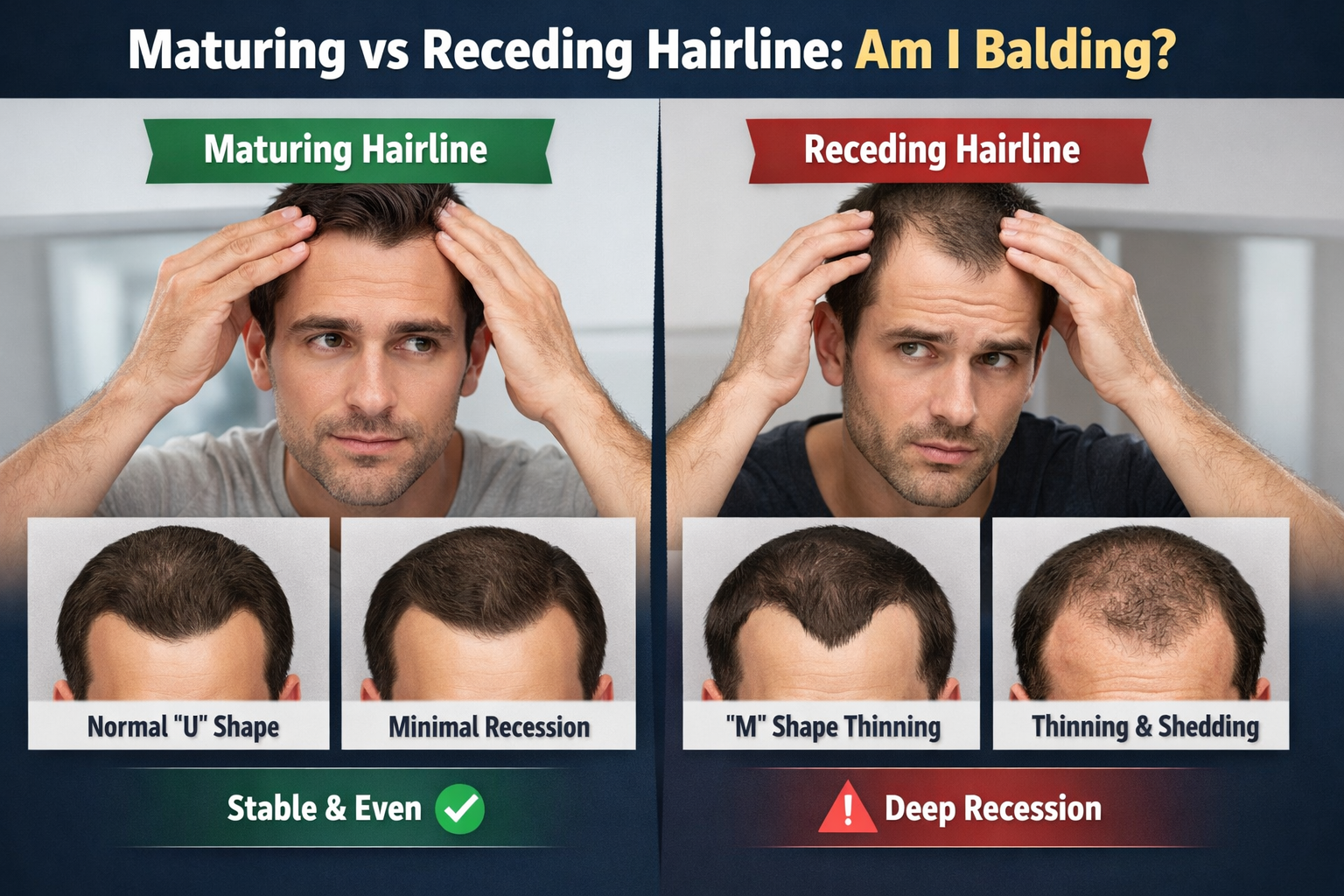
A changing hairline is one of the earliest concerns men notice—often quietly, over time. The temples appear slightly prominent, the forehead broader, and the question becomes difficult to ignore: Is this normal aging, or Am I balding?
This uncertainty can lead to anxiety, rushed decisions, or unnecessary hair restoration treatments. But, on a good note, if you’re aware early, this creates an opportunity—to understand the pattern, intervene appropriately, and achieve natural, long-term results when needed.
This blog will help you differentiate between a maturing hairline and true hair loss, while also explaining when treatment—including a hair transplant—becomes the right step.
The “Mature” Hairline: Natural Growth, Not Balding
A maturing hairline is a normal biological transition. As men move from adolescence into adulthood, the hairline typically shifts slightly upward and becomes more defined.
This is not hair loss—it is structural refinement.
What defines a maturing hairline:
- Mild, symmetrical recession at the temples; about half an inch to an inch above the highest wrinkle on your forehead
- Slightly more V-shaped or U-shaped appearance
- Strong density behind the frontal line
- Stability over time without continued recession
In most cases, this change occurs in the early 20s and then stabilizes. It’s not a sign of impending baldness; it’s simply your facial structure settling into adulthood.
A Receding Hairline: The Beginning of Pattern Hair Loss
A receding hairline is different. It’s not a one-time shift; it’s a progressive retreat. This is usually the first sign of Androgenetic Alopecia (Male Pattern Baldness).
You’ll notice the "M-shape" becoming more pronounced. The hair at the temples doesn't just move back; it becomes thinner, shorter, and "wispy" before disappearing entirely.
Clinical indicators of a receding hairline:
- Progressive temple recession over months or years
- Visible thinning or miniaturization of hair
- Increased shedding
- Uneven or asymmetrical hairline changes
- Possible crown thinning
If you notice that you can see more of your scalp under bright lights, or if your hair feels "softer" and less manageable than it was two years ago, the follicles are likely miniaturizing.
Hairline Stages: Overview of Progression
While doctors use structured classifications like the Norwood scale, a simplified understanding is often more useful for patients:
- Early stage (Stage 1–2): Likely a maturing hairline or minimal recession
- Moderate stage (Stage 3): Noticeable temple recession, early balding pattern
- Advanced stages (Stage 4 and above): Deeper recession with crown involvement
Hair transplants are typically considered when the pattern becomes clearly established and predictable.
When Should You Consider a Hair Transplant?
A hair transplant becomes a suitable option when certain clinical conditions are met, especially for those considering a hair transplant in Mangalore for long-term correction.
You may be a good candidate if:
- Hair loss pattern is stable or clearly progressing
- You are generally above your early 20s
- Donor hair (back of scalp) is strong and sufficient
- Medical treatments alone are not enough
- You seek natural, long-term correction—not quick fixes
Hair transplantation is a strategic decision, not an urgent one. Proper timing significantly improves outcomes.
Treatments for Hair Restoration: Understand Your Choices Before Surgery
Hair restoration is not limited to surgery. There are multiple approaches to maintain and regain a voluminous, bouncy hair. If you are considering hair transplant in Mangalore, here are a few treatment options that are ideally good for hair restoration.
1. Medical Management: The First Step Before Considering a Hair Transplant
Most men can benefit from medical treatment to control ongoing hair loss. This step is essential because a hair transplant works best on a stable foundation, not an actively thinning scalp.
Hair loss is often progressive. If you only replace lost hair without slowing the process, the surrounding native hair may continue to thin. This can affect long-term results.
What medical management actually does:
- Slows down the progression of hair loss
- Improves the thickness and quality of existing hair
- Helps preserve your current hairline for longer
Why this step matters:
- It creates a stable base before any surgical planning
- It reduces the risk of needing repeated procedures
- It supports more natural-looking, long-lasting results
What patients should realistically expect:
- Gradual improvement, not instant regrowth
- Better hair quality rather than complete reversal
- The need for consistent, long-term use
Important to understand:
Medical treatment does not “cure” hair loss. It helps control and manage it. When combined with the right timing for surgery, it significantly improves overall outcomes.
This is why experienced surgeons rarely recommend jumping straight to a transplant without first stabilizing the condition.
2. The Gold Standard: FUE Hair Transplant
Follicular Unit Extraction (FUE) is the most sought-after procedure in modern clinics.
- The Process: Individual hair follicles are extracted from the "donor area" (usually the back of the head, where hair is genetically resistant to balding) and implanted into the thinning areas.
- The Benefits: No linear scars, very short recovery time (usually 5–7 days), and extremely natural-looking results.
- The Risk: It requires a high level of surgical skill. If the follicles are handled roughly, they won't "take," and you’ve wasted limited donor hair.
This is why FUE is widely preferred by patients opting for a hair transplant in Mangalore, as it offers precision, minimal downtime, and natural-looking outcomes.
3. Advanced Growth Therapies (PRP/GFC)
For those in the early stages of a receding hairline, surgery might not be necessary yet. Platelet-Rich Plasma (PRP) or Growth Factor Concentration (GFC) involves using your own blood’s growth factors to "wake up" dormant follicles.
- The Benefits: Non-surgical, zero downtime, and great for thickening existing hair.
- The Risk: It won't grow hair on a completely bald spot. It’s a maintenance tool, not a miracle cure for late-stage balding.
What the Internet Doesn't Tell You
When you search "Am I balding?", you get a lot of scary charts. Here is the reality of what happens in the consultation room:
1. The "Donor Bank" is Finite
You don't have an unlimited supply of hair. Every graft taken from the back of your head is one less you have for the future.
An experienced hair transplant surgeon won't just look at your hairline today; they will plan for what you might look like at age 50. Using up all your donor hair to create a very low, straight hairline at age 25 is a recipe for regret later in life.
2. The Angle Matters More Than the Density
A "robotic" looking transplant happens when the hairs are implanted at the wrong angle. Natural hair doesn't grow straight up; it grows at specific, subtle angles that change across the scalp. Surgical judgment—the "artistic eye" of the doctor—is what makes the difference between a transplant people notice and one they never suspect.
3. Shock Loss is Real
After a transplant, it’s common for the newly implanted hair (and sometimes the surrounding hair) to fall out. This is called "shock loss." Don't panic. The follicle is still there, safely rooted. The hair will start growing back permanently in 3–4 months, with full results visible around the one-year mark.
Anatomy and Misconceptions
A common myth is that wearing hats or using too much gel causes a receding hairline. In reality, it’s almost entirely down to DHT (Dihydrotestosterone)—a hormone that causes follicles to shrink over time.
Another misconception is that you can "fix" a receding hairline with just vitamins. While nutrition is vital for hair quality, no amount of Biotin will stop a genetically programmed receding hairline. You need a clinical intervention—either medical (like Finasteride or Minoxidil) or surgical.
Making the Decision
If you’re still unsure, try the "Wrinkle Test." Raise your eyebrows as high as possible to create wrinkles on your forehead. If your hairline is about 1–2 finger-widths above the top wrinkle, it’s likely a mature hairline. If it’s significantly higher or the skin there looks shiny and smooth, it’s time to speak with a specialist.
A changing hairline does not always mean you are balding. However, when hair loss becomes progressive, early and informed intervention can make a meaningful difference.
Whether you choose to embrace the change, start a medical routine, or opt for a transplant, the goal is the same: feeling like yourself when you look in the mirror.
At Radiant Roots, a top cosmetic surgery clinic in Mangalore, patients receive expert care with clarity, precision, and a strong focus on long-term outcomes—ensuring that every decision supports both present appearance and future balance.
Getting a professional assessment is the only way to replace anxiety with a plan. You don't have to wait until the hair is gone to take control—sometimes, the best time to act is when you’re still just "wondering."
FAQs:
1. How do I know if my hairline change is temporary or permanent?
A temporary change is usually linked to stress, illness, or seasonal shedding and tends to stabilize. A permanent change shows a clear pattern—gradual temple recession, reduced density, and consistent progression over time. If the shape keeps shifting over months, it’s likely permanent.
2. At what point does a receding hairline require medical treatment?
Medical treatment is usually recommended when there is visible thinning or early recession that continues over time. Starting early helps slow progression and preserve existing hair, even if surgery is not immediately required.
3. Is it better to start treatment early or wait until hair loss becomes visible?
Early intervention is always more effective. Once hair follicles shrink significantly, recovery becomes difficult. Starting treatment at the right time helps maintain density and reduces the need for aggressive procedures later.
4. Can a hair transplant look natural if done at an early stage?
Yes, but only if planned carefully. The hairline must be designed based on future hair loss, not just current appearance. Overly aggressive or low hairlines in young patients often look unnatural over time.
5. What happens if I delay treatment for a receding hairline?
Delaying treatment allows hair loss to progress, which can reduce available donor hair and limit future options. It may also require more extensive correction later instead of simpler, early-stage management.
6. Will I need more than one hair transplant in my lifetime?
Possibly. Hair loss is progressive. A well-planned first transplant can last for years, but additional sessions may be needed depending on future hair loss patterns and individual goals.
7. How does a hair transplant surgeon decide the right hairline for me?
Hairline design is based on facial proportions, age, hair characteristics, and future hair loss risk. The goal is to create a natural, age-appropriate look that remains balanced over time.
8. Can thinning hair around the transplant area affect results later?
Yes. Native hair can continue to thin after a transplant. This is why stabilizing hair loss with medical treatment is important to maintain overall density and avoid patchy results.