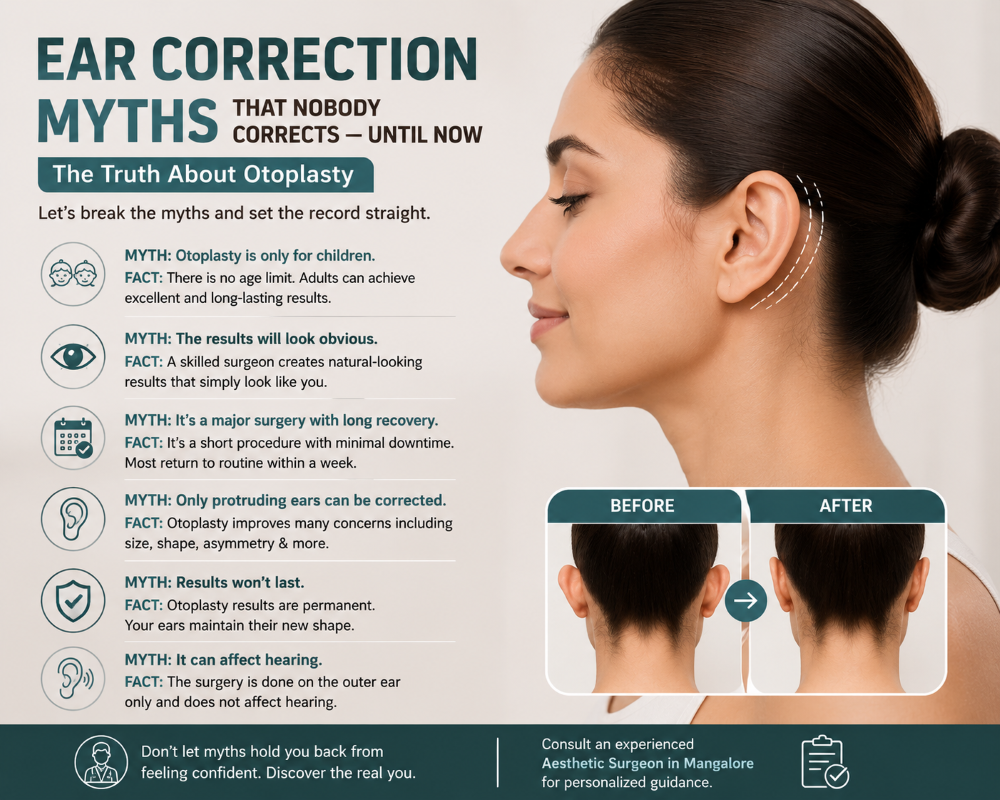
There is a lot of quiet misinformation floating around about otoplasty, that is, ear reshaping surgery. Most of it never gets challenged directly, which means people carry assumptions about the procedure for years, sometimes decades, without ever questioning whether they're actually true.
Some of these myths stop people from getting help they could have had years ago. Others create unnecessary anxiety in people who are genuinely ready to move forward.
This article is specifically about setting the record straight - myth by myth, clearly and honestly, so that you can make an informed decision rather than one based on something you half-heard years ago.
Myth #1: Otoplasty Is Only for Children
The myth: Ear surgery is something that is only done during your childhood. If you didn't have it done then, you've missed the window.
The fact: There is no age limit for otoplasty. Adults in their 30s, 40s, and beyond undergo the procedure regularly and often with better outcomes than children.
Here's why: adult ear cartilage is fully developed and stable. That means a surgeon can work with greater precision and predict results more accurately. Children's cartilage is still forming, which introduces more variability.
Adults also bring a clear understanding of what they want, which makes the entire process of consultation, procedure, and recovery more focused and self-directed.
If anything, adults are ideal candidates. The only thing stopping most of them is the false belief that the window has already closed.
Myth #2: The Results Will Look Very Obvious
The myth: People will be able to tell right away that you've had something done to your ears.
The fact: A well-performed otoplasty is designed to be unnoticeable and not invisible in the sense that nothing changed, but natural in the sense that the result simply looks like you.
The goal of any skilled aesthetic surgeon in Mangalore performing otoplasty isn't dramatic transformation. It's proportion and balance. The ears should look like they've always belonged on your face, just positioned or shaped in a way that feels right.
Incisions are made behind the ear, completely hidden from view. Swelling resolves within a few weeks. What remains is a result that most people around you won't be able to pinpoint: they'll sense something looks more balanced, but won't know exactly what changed.
That's not a limitation of the procedure. That's the point.
Myth #3: It's a Major Surgery With a Long, Painful Recovery
The myth: Ear surgery means weeks of downtime, significant pain, and a long road back to normal life.
The fact: For adults, otoplasty is typically performed under local anaesthesia in a single outpatient sitting lasting one to two hours. There is no overnight hospital stay in most cases.
The recovery is straightforward:
- A protective headband or soft bandage is worn for the first week
- A little swelling and tenderness are very normal for a few days
- Most adults return to desk work or daily routines within 5 to 7 days
- Strenuous activity is paused for about 4 to 6 weeks
- Final results are visible once swelling fully settles, usually within 4 to 6 weeks
It is a planned, manageable procedure and not a major surgical event. Most patients are surprised by how comfortable the experience actually is compared to what they had imagined.
Myth #4: Only People Whose Ears "Stick Out" Can Have It Done
The myth: Otoplasty is specifically for protruding ears, if that's not your exact concern, it doesn't apply to you.
The fact: Otoplasty addresses a much wider range of concerns than most people realise:
- Ears that sit at different heights on either side of the face
- Ears that appear too large or disproportionate in relation to the face
- Ears with unusual folds, curves, or shapes
- Asymmetry between one ear and the other
- Structural concerns from minor injuries or genetic factors
If you've had a lingering concern about the shape, size, or position of your ears, regardless of whether "sticking out" is the right description, the procedure may still be relevant to you. The best way to know is a direct consultation with a qualified professional, not a self-assessment based on a narrow definition of the problem.
Myth #5: The Results Won't Last - Your Ears Will Eventually Go Back
The myth: Like many cosmetic treatments, the results of otoplasty are temporary and will need to be repeated.
The fact: Otoplasty results are permanent.
Once the cartilage is reshaped and healed, it holds its new position. Unlike injectables such as dermal fillers or Botox that gradually wear off, or non-surgical treatments that require maintenance sessions, otoplasty is a one-time procedure. The structural change is permanent.
There is no going back. There is also no going back to square one. Once healed, your ears simply maintain their corrected position - naturally, permanently, and without ongoing intervention.
Myth #6: Otoplasty Will Affect How Well You Can Hear
The myth: Any surgery on or near the ear must carry some risk to hearing.
The fact: Otoplasty works entirely on the outer structure of the ear, that is, its shape, position, and appearance. It does not involve the ear canal, the middle ear, or any component of the auditory system.
Hearing is completely unaffected. Though it is one of the most persistent fears around the procedure, it has no connection with how the surgery actually works.
So Who Is Actually the Right Candidate?
If you've been reading through these myths and finding that they applied to your own assumptions and that's quite common.
Now here's a simple checklist to find out if you care the right candidate for otoplasty:
- Your ears protrude noticeably, appear uneven, or have a shape that has bothered you
- It has influenced your choices in hairstyles, photographs, social comfort
- You are in good general health with no active infections around the ear
- You have realistic expectations about the outcome (balance and proportion, not perfection)
- You are a non-smoker, or are willing to pause smoking before and after surgery
The right next step is a consultation at a reputable aesthetic clinic in Mangalore where a trained professional can assess your specific ear structure and give you a clear, honest picture of what's achievable.
You Don't Have to Keep Carrying This
Myths are powerful precisely because they go unchallenged. If any of the ones above had been shaping your thinking about otoplasty and now you know the truth.
Adults choose cosmetic surgery in Mangalore for ear correction at every age, often describing it as one of the most straightforward decisions they ever made for themselves. Not because it changes who they are, but because it removes a quiet weight they'd been carrying far longer than necessary.
If you're ready to move past the myths and get clear answers about your specific situation, a conversation with an experienced aesthetic surgeon in Mangalore is where that starts.
Frequently Asked Questions
1. Is there a minimum or maximum age for otoplasty?
Children are generally considered candidates from around age five or six, when ear development is mostly complete. For adults, there is no upper age limit. As long as you are in good general health, otoplasty is appropriate at any adult age.
2. How noticeable are the scars after ear reshaping surgery?
Incisions are made behind the ear in the natural crease, making them almost entirely hidden from view. Once fully healed, scarring is minimal and virtually invisible in normal settings.
3. Can otoplasty fix only one ear if the concern is on one side?
Yes. The procedure can be performed on one ear only, or on both. Your surgeon will assess symmetry during the consultation and advise on whether correcting one side alone would achieve the balance you're looking for, or whether both would benefit.
4. What's the difference between seeing a cosmetic surgeon versus a general doctor for this?
An aesthetic surgeon with specific training in cosmetic surgery approaches otoplasty with an understanding of facial proportion and appearance outcomes, not just the technical aspects of the procedure. For a result that looks natural and balanced, that specialisation matters significantly.
5. How soon after the procedure can I return to work?
Most adults return to desk-based work or routine daily activities within 5 to 7 days. Physical work or contact sport requires a longer pause of around 4 to 6 weeks. Your surgeon will give you specific guidance based on your role and recovery progress.