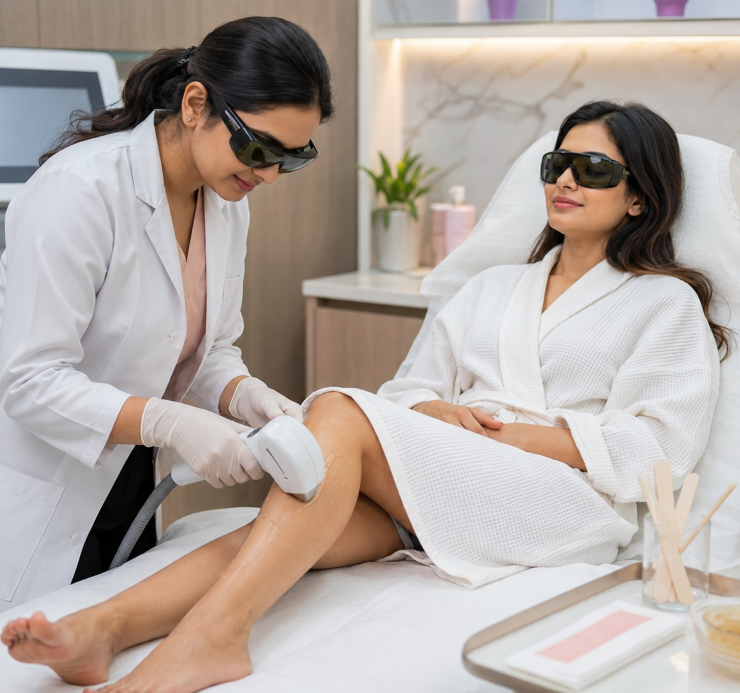
You wax, and for a few days your skin feels smooth. Then the stubble starts poking through again, and the whole routine repeats - the appointments, the discomfort, the ingrown hairs that show up right when you don't want them to. It's exhausting, and a lot of patients start wondering if there's a better way.
Laser hair removal is often the next thing people consider, and for many, it brings a real shift toward smoother, more manageable skin over time. This blog will guide you through what changes to expect along the way.
Individual results may vary. Please consult your treating doctor for a personalised assessment before starting any treatment.
How the Two Methods Actually Work
The difference in results starts with a difference in mechanism.
| Waxing | Laser Hair Removal | |
| How it acts on hair | Physically pulls hair out from the root | Uses light to target pigment inside the follicle |
| Effect on regrowth | Returns at roughly the same thickness | Gradually weakens the follicle over sessions |
| What it removes | Only what's visible, each time | Works below the surface, not just visible hair |
This is the starting point for everything else that changes across a course.
How Hair Texture Changes Over Sessions
Waxing pulls hair from the root each time, but regrowth stays the same thickness. Laser hair removal in Mangalore works differently, it targets the hair follicle directly.
- Hair often becomes finer with each session
- Regrowth tends to slow down gradually
- Some areas respond faster than others
- Coarse, dark hair usually responds better than fine or light hair
This gradual shift is one of the clearest differences patients notice over a full course, though the pace varies from person to person.
Who Tends to See Faster Change?
Not every patient sees the same rate of progress, and a few factors explain why:
- Hair colour and thickness affect how well laser targets the follicle
- Naturally darker, coarser hair typically responds more visibly
- Fine, light, or grey hair may need more sessions or additional guidance
- Hormonal factors can influence how quickly hair returns in certain areas
None of this means lasers won't work for finer hair, it simply means the pace of visible change can differ, which is worth discussing during a skin assessment. Your personal doctor will clear your doubts on this and give you a proper idea on what to expect out of the sessions.
How Skin Reacts Differently Over Time
Skin behaves differently with each method, especially with repeated use.
| Waxing | Laser Hair Removal | |
| Common reaction | Redness, ingrown hairs | Mild warmth, temporary redness |
| Frequency of irritation | Often, every session | Usually reduces over sessions |
| Risk with sensitive skin | Higher, due to pulling | Lower, if settings are suited to skin type |
Waxing repeatedly stresses the skin in the same way each time. Laser tends to become more comfortable as hair thins with sessions, though individual skin response can still vary.
Comparing Time and Cost Realistically
This is where patients often want a straight answer, and a simple comparison helps.
| Waxing (Ongoing) | Laser Hair Removal (Course) | |
| Frequency | Every 3 to 4 weeks, indefinitely | Every 4 to 6 weeks, for a set course |
| Long-term time spent | Continuous, does not reduce | Reduces as sessions progress |
| Cost pattern | Recurring, ongoing expense | Upfront over a course, then minimal touch-ups |
The laser hair removal cost in Mangalore typically depends on the treatment area and number of sessions needed, and a clear plan is usually shared after an in-person skin assessment.
What Laser Hair Removal Typically Costs
As a general reference, pricing for laser hair removal in Mangalore typically falls in the range:
| Area Size | Approximate Price Range |
| Smaller zones (upper lip, chin) | Starting around ₹1,500 per session |
| Medium zones (underarms, bikini line) | Mid-range, varies by clinic and settings used |
| Larger zones (full arms, legs, back) | Up to ₹10,000 per session, depending on area |
Full-body plans and combo packages are usually available at adjusted package pricing. These figures are approximate and can vary by clinic, technology used, and number of sessions required. Actual cost is best confirmed during a consultation.
Why Mixing Methods Can Undo Progress
Patients sometimes wax or thread between laser sessions out of habit, but this can affect how well the laser works.
- Threading and waxing help remove the hairs from the root
- The laser needs hair present at the root to target it effectively
- Switching between methods in-between the course can reduce session effectiveness
- Shaving is usually fine between sessions, unlike waxing or threading
Sticking to one method through a course tends to give a clearer sense of actual progress.
Aftercare Habits That Support Better Results
Skin needs a little care between sessions, regardless of which method was used before switching to laser.
- Avoid direct sun exposure on treated areas for a few days
- Use a mild, fragrance-free moisturiser to calm the skin
- Skip harsh scrubs or active ingredients right after a session
- Wear loose clothing over treated areas to reduce friction
Small habits like these make the skin's response to each session more consistent.
Myth or Fact? Let's Set It Straight
A lot of confusion around laser hair removal comes from myths rather than facts.
- "It's extremely painful."
Most patients describe it as a mild, warm snap, often less intense as sessions progress. - "It removes hair permanently."
with nothing needed after." It offers long-term reduction for most patients, not complete permanent removal; occasional touch-up sessions are common, and hair that returns is usually finer and lighter. Results vary from person to person. - "It causes cancer."
Laser hair removal uses light-based energy, not radiation linked to cancer, and there's no established evidence connecting the two. - "It can't be done on the face."
Yes, it can, by adjusting the settings to facial skin, which tends to be more sensitive. - "It's completely risk-free."
Mild redness or sensitivity is common after sessions, and if aftercare is skipped, then rare issues like pigmentation changes may occur.
Beyond the Routine: Know The Real Difference
Waxing and laser hair removal solve the same problem in different ways. While waxing offers a quick fix, laser hair removal works gradually, aiming for longer gaps between sessions and reducing regrowth over time. Neither is without its own adjustments, and individual results may vary.
If you're weighing which approach suits your skin and routine, it's worth discussing it with a qualified doctor for a personalised assessment.
Author:
Dr. Chandra
- Board-certified Plastic and Cosmetic Surgeon (MCh)
- The Lead Surgeon at Radiant Roots Hair Transplant & Aesthetic Surgery Centre, Mangalore.
Frequently Asked Questions
Q1. How long do laser hair removal results actually last?
Results can last months to years, depending on hormones, hair type, and area treated. Touch-up sessions are common to maintain smoothness over time.
Q2. Can I use threading after a laser hair removal session?
It's best to avoid threading between sessions, as it removes hair from the root. Shaving is usually the safer option during an ongoing course.
Q3. Which type of laser is considered gentler for sensitive skin?
Diode lasers are commonly used for sensitivity and are often paired with cooling technology. A doctor can recommend what suits your specific skin type.
Q4. Is laser hair removal suitable for brown or darker skin tones?
Certain laser types are designed to work across various skin tones. A skin assessment beforehand helps confirm which settings are appropriate.
Q5. Are laser hair removal and electrolysis the same treatment?
No. Laser targets pigment in hair follicles using light, while electrolysis treats each follicle individually using an electric current. They work differently.
Disclaimer: This content is for general educational purposes only and does not constitute medical advice. Outcomes vary between individuals. Please consult your treating doctor for a personalised assessment before starting any treatment.