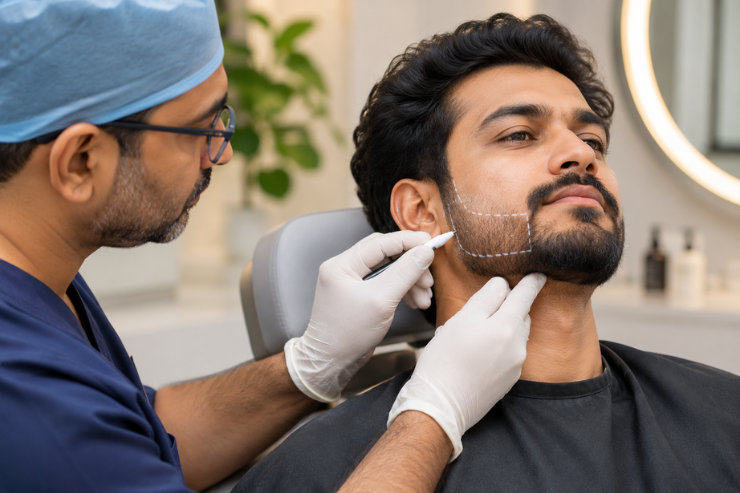
A beard may grow densely in one person and remain sparse or uneven in another. Genetics plays a major role, but scars, previous injury, skin conditions, and other forms of hair loss can also affect facial hair.
For someone researching a beard transplant, an important point to understand is that the procedure is not simply about “adding more hair.” Facial hair has its own direction, angle, density, and pattern. A transplant therefore needs to consider both where the follicles come from and how they are positioned on the face.
Here is what facial hair restoration involves, who may be assessed for it, and what recovery generally looks like.
An Overview of Beard Transplant
A beard transplant is quite similar in principle to a scalp hair transplant. Healthy hair follicles are taken from a suitable donor area, usually from the scalp, and carefully placed into areas of the beard where hair is naturally sparse or absent.
The procedure may be considered for different reasons. Some men naturally have a patchy or thin beard, while others may have areas where facial hair does not grow because of a stable scar, previous injury, burn, surgery, or another cause.
What makes beard transplantation different is the way facial hair grows. Beard hairs change direction across the moustache, cheeks, chin, jawline, and sideburns. Their thickness and angle may also differ from scalp hair.
So, planning is not simply about filling an empty area. The donor hair, existing beard pattern, facial proportions, and natural direction of growth all need to be considered before deciding whether facial hair restoration is suitable.
Where Does the Hair for a Beard Transplant Come From?
The donor follicles are commonly taken from a suitable part of the scalp.
Why is donor-hair selection important?
Scalp and beard hair are not identical.
The doctor may assess:
- Hair thickness
- Texture
- Curl pattern
- Colour
- Follicular-unit size
- Donor density
- How closely the donor hair resembles existing beard hair
The goal of donor assessment is not simply to find an area with “enough hair.” The characteristics of that hair also matter when planning facial placement.
How Is a Beard Transplant Performed?
Follicular Unit Excision, or FUE, is one technique used for facial hair transplantation. Individual follicular units are removed through small circular openings in the donor area.
The process can be understood in three main stages.
1. Facial design and planning
Before graft placement, the proposed beard pattern needs to be assessed in relation to:
- Existing facial hair
- Cheek and jawline anatomy
- Moustache and chin pattern
- Facial proportions
- Areas of thinning
- Personal grooming preferences
A full beard is not the only possible goal. Some people may be concerned about a particular patch, moustache gap, sideburn, or scar.
2. Follicles are obtained from the donor area
Suitable follicular units are carefully extracted.
Single-hair and multi-hair follicular units may then be separated so they can be used in different parts of the beard pattern.
3. Recipient sites are created
This is one of the most important technical differences between scalp and beard transplantation.
Beard hairs often leave the skin at very acute angles and change direction across the cheeks, jawline, moustache, and chin.
Recent literature on facial hair restoration emphasises that recipient-site angle, direction, graft preparation, and facial design are central aspects of beard transplantation. (pubmed.ncbi.nlm.nih.gov)
If follicles are placed at unsuitable angles, the growing hair may appear too upright or may not follow the surrounding beard pattern.
Who May Consider Facial Hair Restoration?
People explore beard transplantation for several different reasons.
These may include:
- Naturally sparse facial hair
- Uneven beard distribution
- Congenital areas with little facial hair
- Stable scars following injury
- Previous burns
- Certain stable post-surgical scars
- Loss of hair following previous skin inflammation
- Correction of an earlier facial-hair transplant
Published Indian literature on beard reconstruction describes transplantation for congenital low density as well as selected stable scars caused by burns, trauma, acne, and surgery.
However, having a patch without beard hair does not automatically mean transplantation is appropriate.
When Should Beard Hair Loss Be Assessed First?
Sudden beard hair loss deserves a medical assessment before cosmetic restoration is considered.
For example, alopecia areata can cause smooth, sharply defined patches of facial-hair loss. Hair transplantation is generally not appropriate while this condition is active because the underlying disease can continue to affect follicles.
Other skin or inflammatory conditions may also need to be stabilised first.
Assessment may therefore look at:
- When the hair loss started
- Whether it is stable or progressing
- Skin redness, scaling, or inflammation
- Previous acne or scarring
- Medical history
- Existing beard density
- Donor-area quality
- Expectations from the procedure
For transplantation into scar tissue, the condition and stability of the scar also matter because scarred skin behaves differently from normal facial skin.
What Happens After a Beard Transplant?
Early recovery requires care because newly placed follicular units need time to settle.
During the first few days
It is common to experience some:
- Redness
- Mild swelling
- Small crusts around implanted follicles
- Temporary numbness or sensitivity
- Tightness in the treated area
Clinical literature on beard reconstruction describes mild redness, swelling, and crusting during early healing. (pmc.ncbi.nlm.nih.gov)
Avoid rubbing or picking
Newly transplanted areas should not be scratched, rubbed, or picked.
Crusts should be allowed to loosen according to the washing or moisture instructions provided by the treating team.
Washing and shaving need to be gradual
There is no single aftercare schedule suitable for everyone.
The treating doctor should advise when normal face washing, skincare, shaving, trimming, exercise, and other routines can safely resume.
Published postoperative protocols vary, which is why personalised instructions should take priority over generic online timelines.
Will the Transplanted Hair Look Exactly Like Natural Beard Hair?
Not always. The transplanted hair can be planned to blend with the existing beard, but it does not become biologically identical to natural beard hair.
This is because the transplanted follicles usually come from the scalp. Even after they are moved to the beard area, they retain many of the characteristics of the donor hair.
What differences may remain?
Transplanted scalp hair may differ from natural beard hair in:
- Thickness: Beard hair is often coarser than scalp hair.
- Texture: The curl or wave pattern may not be exactly the same.
- Growth rate: Scalp-derived hair may grow longer and may need more frequent trimming.
- Follicular grouping: Natural beard hair and scalp hair can have different follicular-unit patterns.
What helps transplanted hair blend better?
The visual result depends on more than the donor hair itself.
Important factors include:
- Selecting donor hair with a suitable thickness and texture
- Using appropriate single- and multi-hair follicular units
- Matching the natural direction of surrounding beard hair
- Placing hairs at a low, natural angle
- Following the existing moustache, jawline, cheek, and chin pattern
- Planning density according to the surrounding facial hair
This is why the angle and direction of implantation are particularly important in facial hair restoration.
Will it need to be trimmed differently?
Possibly.
Because transplanted scalp hair may continue to grow more like scalp hair, it may need to be trimmed more often than natural beard hair.
Over time, grooming usually becomes part of maintaining a consistent beard length.
So, the more accurate answer is:
Transplanted beard hair can be planned to blend naturally with existing facial hair, but it may not behave exactly like native beard hair because it retains characteristics of the donor site.
Beard Transplant Planning Is About More Than Filling Gaps
Someone searching for a beard transplant in Mangalore may naturally focus on how much facial hair can be added. Clinically, the more useful questions are different:
Why is the area sparse? Is the condition stable? Is suitable donor hair available? And can the follicles be placed in a way that respects the natural direction of facial hair?
A careful facial hair restoration plan therefore begins with diagnosis, donor assessment, facial design, and realistic expectations—not simply a graft number.
Individual results, healing, hair characteristics, and suitability vary. A qualified medical practitioner should assess the facial-hair pattern, donor area, skin condition, medical history, and goals before recommending a personalised approach.
Author
Dr. Chandra
Board-certified Plastic and Cosmetic Surgeon (MCh)
The Lead Surgeon at Radiant Roots Hair Transplant & Aesthetic Surgery Centre, Mangalore.
Frequently Asked Questions About Beard Transplant
Can beard transplant be done for a patchy beard?
Sometimes. The first step is identifying why the patch is present. Stable naturally sparse areas may be assessed differently from active alopecia or inflammatory hair loss.
Is FUE used for beard transplantation?
Yes. FUE is one established method for obtaining individual follicular units for facial hair restoration. (pubmed.ncbi.nlm.nih.gov)
Does donor hair grow exactly like beard hair?
Not always. Scalp donor hair retains many of its original characteristics, which is why texture and calibre matching are considered during planning.
Can a beard transplant be performed over a scar?
Selected stable scars may be considered, but scar thickness, blood supply, cause, and stability need assessment first.
This article is for general educational purposes and does not constitute medical advice. Individual results vary. Please consult a qualified medical practitioner for a personalised assessment.