You eat well and exercise, yet the belly still bulges or hangs. Two surgeries keep coming up, and it is hard to tell which one applies to you. The answer depends on the cause: fat, loose skin, muscle, or a mix. This blog explains how each cause points to a different option, so you can weigh liposuction or tummy tuck with clear information and discuss it with your doctor.
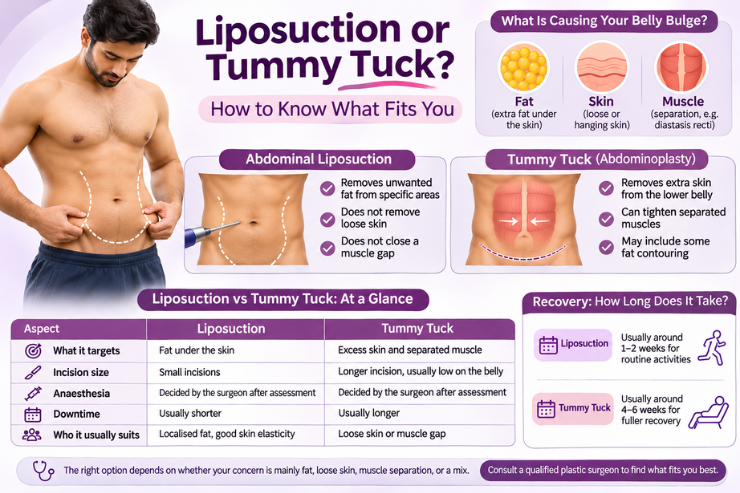
What Is Causing Your Belly Bulge: Fat, Skin or Muscle?
Most belly concerns come from one or more of these three causes. Knowing which one applies helps you understand your options.
The pinch test: what it tells a surgeon
Gently pinch the skin on your lower belly.
- A thick, soft layer that lifts easily usually suggests fat under the skin.
- Skin that hangs, folds, or feels thin and loose usually suggests excess skin.
This is only a first idea. A proper examination is needed to be sure.
Why a belly can still bulge after pregnancy
During pregnancy, the two long muscles in the front of the belly can move apart. This is called diastasis recti. The gap may stay open afterwards, and diet or exercise may not close it. It often shows as a bulge in the centre of the belly.
| What you notice | What it usually points to | What is usually considered |
|---|---|---|
| Soft, pinchable fat in one or two areas | Fat under the skin | Liposuction |
| Skin that hangs or folds | Excess skin | Tummy tuck |
| Centre bulge after pregnancy | Muscle separation | Tummy tuck |
| A mix of the above | More than one cause | Assessment by a surgeon |
Abdominal Liposuction in Mangalore: What It Can Do
What it removes
Liposuction removes fat that sits under the skin in specific areas, such as the lower belly or flanks.
What it does not do
- It does not remove loose skin.
- It does not close a muscle gap.
- It is not a weight-loss surgery. The American Society of Plastic Surgeons also notes that liposuction is not a substitute for weight loss.
Who it usually suits
- People with a stable body weight
- Fat that is localised to certain areas
- Skin that still has good elasticity
What Does a Tummy Tuck Do Differently?
Removing extra skin and tightening muscle
A tummy tuck (abdominoplasty) removes extra skin from the lower belly. The surgeon can also stitch the separated muscles closer together. This changes both the surface and the support underneath.
Does a tummy tuck remove fat too?
It can include some contouring of the area. However, removing fat is not its main aim. Its focus is on skin and muscle.
Who it usually suits
- Loose skin after pregnancy or major weight loss
- A muscle gap after pregnancy
- Stable weight and good general health
Liposuction vs Tummy Tuck: Side-by-Side
This table is for information only. Neither option is right for everyone.
| Liposuction | Tummy Tuck | |
|---|---|---|
| What it targets | Fat under the skin | Excess skin and separated muscle |
| Incision size | Small incisions | Longer incision, usually low on the belly |
| Anaesthesia | Decided by the surgeon after assessment | Decided by the surgeon after assessment |
| Downtime | Usually shorter | Usually longer |
| Who it usually suits | Localised fat, good skin elasticity | Loose skin or muscle gap |
Where will the scars be?
- Liposuction leaves small marks at the incision points.
- A tummy tuck leaves a longer scar, usually placed low so clothing can cover it.
As a general guide, liposuction marks are often about 0.5 to 1 cm each. A tummy tuck scar commonly runs across the lower belly, with another around the navel. Scars usually fade over several months. This is a generic guideline, and your treating doctor can tell you what applies to you.
How long is the recovery for each?
Recovery differs for each person and each procedure.
- As a general guide, many people return to desk work in about 3 to 7 days after liposuction and wear a compression garment for a few weeks.
- After a tummy tuck, desk work often resumes in about 1 to 2 weeks, with heavy lifting avoided for around 4 to 6 weeks.
Swelling can take months to settle. These are approximate timelines. Your treating doctor can confirm the actual recovery for you.
Is a hospital stay needed after tummy tuck or Liposuction?
This depends on the procedure, the extent of surgery, and your health.
- As a general guide, liposuction is often done as a day-care procedure or with an overnight stay.
- A tummy tuck commonly needs 1 to 2 nights.
This is a generic guideline, and your treating doctor will advise what applies to you.
Will Liposuction Tighten Loose Skin?
This is the question patients ask most. In simple terms, liposuction removes fat. It is not designed to tighten loose skin.
How skin elasticity affects the result
After fat is removed, the skin needs to settle back on its own. Younger skin or skin with good elasticity usually adapts better. Skin that has stretched a lot may not.
When liposuction alone may not be enough
If skin hangs or folds, liposuction alone may leave it looking loose. In such cases, a different procedure may suit you better. Your surgeon will explain this after examining you. Results vary from person to person.
Read more: "Sagging, Flatness, or Loose Skin? There's a Fix for Each."
Can You Have Both Together?
When surgeons combine them
Some people have both extra fat and loose skin or a muscle gap. In such cases, a surgeon may discuss combining the two. This is also a part of many Mommy Makeover plans.
Safety limits and staged surgeries
- There are limits to how much can be done safely in one sitting.
- Some people may be advised to do the surgeries in stages.
- Your health and the areas involved guide this decision.
When Should You Wait Before Choosing?
If you plan more pregnancies
Pregnancy can change the belly again. Many surgeons suggest discussing timing if you plan to have more children.
If you still have a lot of weight to lose
Neither surgery is meant for weight loss. A stable weight usually gives a more predictable outcome.
Read more: "What Happens If You Gain Weight After Liposuction?"
Smoking and health conditions that affect healing
- Smoking can slow healing.
- Conditions such as diabetes or high blood pressure need to be well controlled.
- Share your full medical history with your surgeon.
Be Double Sure: Talk It Through With Your Doctor
As a simple rule, fat points towards liposuction, while loose skin and a muscle gap point towards a tummy tuck. Many people have a mix, so an examination helps tell them apart. Each option has its own benefits and limits, and the decision is yours. Individual results may vary. Please consult your treating doctor for a personalised assessment. If you have questions, Dr. Chandra and the team are happy to explain the options.
Author:
Dr. Chandra
Board-certified Plastic and Cosmetic Surgeon (MCh)
The Lead Surgeon at Radiant Roots Hair Transplant & Aesthetic Surgery Centre, Mangalore.
FAQs
1. Can I have liposuction or a tummy tuck to lose weight?
No. Neither surgery is meant for weight loss. They reshape specific areas. A stable, healthy weight before surgery usually supports a more predictable result. Your surgeon can guide you based on your health.
2. How long after pregnancy can a tummy tuck be done?
Surgeons usually suggest waiting until the belly has settled and you have finished having children. The exact timing depends on your health, breastfeeding, and weight. Your surgeon will advise you after examining you.
3. Do stretch marks go away after a tummy tuck?
Stretch marks on the skin that is removed, usually below the navel, go with it. Marks elsewhere on the belly may remain, though they may look different. Results vary from person to person.
4. Can belly fat come back after liposuction?
Fat cells removed do not return in the same way. However, remaining fat cells can grow if weight increases. Maintaining a stable weight through diet and activity helps keep the contour.
5. Can I have liposuction after a C-section?
Often, it can be considered once the scar has healed. Your surgeon will check scar tissue, skin quality, and your overall health first. Suitability differs for each person.
Disclaimer: This content is for general educational purposes only and does not constitute medical advice. Individual results may vary. Please consult your treating doctor for a personalised assessment before starting any treatment.