Search "hair transplant" online and you'll find a dozen techniques, each claiming to be better than the last. It gets confusing fast, and Direct Hair Implantation is usually one of the terms patients bring up without fully knowing what it means — just that they've read it somewhere and it sounded advanced.
In my consultations, I've noticed the same pattern: people arrive with fragments of information gathered from forums, videos, and social media, rarely from a reliable clinical source. Some of it is accurate. Much of it isn't. Before you decide anything, it helps to actually understand what Direct Hair Implantation is, how it's performed, and where it fits among the other techniques you may have come across.
What Is Direct Hair Implantation?
I like to think of it as a more refined cousin of FUE (Follicular Unit Extraction). The core idea is the same: individual hair follicles are taken from a donor area — usually the back or sides of the scalp, where hair is genetically resistant to thinning — and relocated to areas experiencing hair loss.
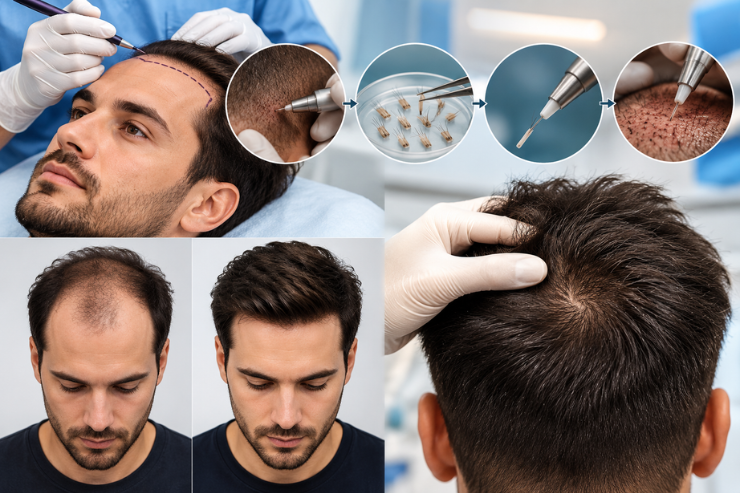
What sets Direct Hair Implantation apart is the implantation method. Instead of creating recipient sites (small incisions) first and placing follicles into them afterward, Direct Hair Implantation uses a specialised pen-shaped tool, often called a Choi Implanter Pen, to extract and implant each follicle in a single, direct motion — with no separate incision step.
In simple terms: extraction and implantation happen almost simultaneously, follicle by follicle.
How Does DHI Work? Step by Step
1. Consultation and Scalp Assessment
Before any procedure, a thorough evaluation of the scalp, hair loss pattern, donor hair density, and general health is carried out. This helps determine whether Direct Hair Implantation is an appropriate option at all — not every case of hair loss requires or benefits from surgery.
2. Donor Area Preparation
The donor area (typically the back of the head) is trimmed and locally anaesthetised so the area is numb and comfortable throughout the procedure.
3. Follicle Extraction
Using a fine, hollow micro-punch tool, individual hair follicles are extracted one at a time directly from the donor area. Each follicle is carefully examined and sorted based on the number of hairs it contains, since this affects how naturally it will blend into the transplanted area.
4. Loading the Implanter Pen
Extracted follicles are loaded into the Choi Implanter Pen — a hollow needle-like device that holds a single follicle at a time.
5. Direct Implantation
The surgeon uses the pen to implant each follicle directly into the recipient area, controlling the angle, depth, and direction of placement in one motion. This is what allows for a very natural-looking hair growth pattern, since hair rarely grows straight up — it has direction and flow.
6. Final Review and Aftercare Instructions
Once implantation is complete, the scalp is gently cleaned, and detailed aftercare guidance is provided to support healing and follicle survival.
Direct Hair Implantation vs FUE: What's the Real Difference?
This is one of the first things patients want clarified, and I always explain it without leaning toward either technique — both have their place:
- FUE: Recipient sites (tiny incisions) are created first; follicles are extracted and implanted afterward.
- Direct Hair Implantation: Extraction and implantation happen in one continuous step using the implanter pen, without pre-made incisions.
Because Direct Hair Implantation skips the separate incision step, it can allow denser follicle packing in some cases, tighter control over implantation angle, and less time spent by follicles outside the body.
Both are legitimate, widely practiced techniques. In my experience, the right choice depends on the individual's scalp condition, donor availability, and clinical judgment on the day — not on which technique "sounds" more advanced.
Who Is a Suitable Candidate for Direct Hair Implantation?
Direct Hair Implantation is generally considered for individuals who:
- Have stable, adequate donor hair density
- Are experiencing pattern hair loss (androgenetic alopecia) that has stabilised
- Are in good general health with no conditions that could affect healing
- Have realistic expectations about outcomes and timelines
Direct Hair Implantation may not suit everyone. Active scalp conditions, certain medical histories, or insufficient donor supply are all factors a surgeon assesses carefully before recommending surgery.
What Are the Potential Benefits?
- Precise control over hair direction, angle, and depth
- No pre-made incisions, which some surgeons feel reduces scalp trauma
- Shorter time outside the body for follicles, which may support survival
- Suitable for scalp, and in some cases, beard or eyebrow restoration
Outcomes vary from person to person, and no technique can guarantee a specific result. Hair growth after any transplant is a biological process that unfolds gradually over months.
Recovery and Aftercare
Immediately After the Procedure
Mild redness, swelling, or scalp sensitivity in the treated area is common and typically settles within a few days.
The First Few Weeks
- Tiny scabs form around implanted follicles and shed naturally
- Some transplanted hairs may shed temporarily — this is a normal, expected phase known as "shock loss"
- Gentle scalp care as advised by the surgeon supports healing
Months 3–12
New hair growth typically begins around the third or fourth month and continues to thicken gradually, with more visible results generally appearing between months 8 and 12.
Every individual's healing timeline differs based on age, scalp health, and aftercare compliance.
Risks and Limitations to Be Aware Of
I believe patients deserve the full picture, not just the appealing part. Like any surgical procedure, hair transplantation — including Direct Hair Implantation — carries some possible risks, such as:
- Temporary swelling, numbness, or scalp tenderness
- Minor infection risk if aftercare instructions aren't followed
- Variation in growth density between individuals
- The possibility that more than one session may be needed in cases of extensive hair loss
I always discuss these openly during consultation, along with a specific scalp assessment, before any decision is made — and any surgeon you speak to should do the same.
In Closing
Hair loss can feel deeply personal, and I've seen how much it helps patients simply to understand their options — clearly, honestly, and without pressure. Techniques like Direct Hair Implantation have given surgeons more precision and control, but no article, including this one, can replace an in-person evaluation of your scalp and hair loss pattern.
If you're exploring your options for a hair transplant in Mangalore, the most useful next step is simply a proper consultation — one where your questions are answered and your scalp is assessed on its own merits.
Author:
Dr. Chandra
Board-certified Plastic and Cosmetic Surgeon (MCh)
The Lead Surgeon at Radiant Roots Hair Transplant & Aesthetic Surgery Centre, Mangalore.
Frequently Asked Questions
1. Does a hair transplant hurt?
Most people feel little to no pain during the procedure itself because the scalp is numbed beforehand. Some mild soreness or tightness afterward is normal and usually manageable with simple care.
2. How long do the results actually take to show?
You won't see instant results — that's a common misunderstanding. New hair usually starts appearing around 3–4 months later, and it keeps getting thicker and fuller for close to a year.
3. Will the transplanted hair fall out again later?
Hair that's moved from the donor area is generally resistant to the hormonal changes that cause pattern baldness, so it tends to grow long-term. However, surrounding natural hair can still thin over time due to ongoing hair loss, which is why some people plan for that separately.
4. Is there a visible scar after this type of transplant?
Since individual follicles are removed one at a time rather than a strip of scalp, any marks left behind are usually tiny and scattered, and they tend to fade and become hard to notice once hair grows back over them.
5. How do I know if I actually need a hair transplant, or if something else would work?
That really depends on why you're losing hair in the first place — genetics, stress, deficiency, or a medical condition can all look similar on the surface but need different solutions. A proper scalp and hair loss evaluation is the only reliable way to know what's actually going on before considering surgery.