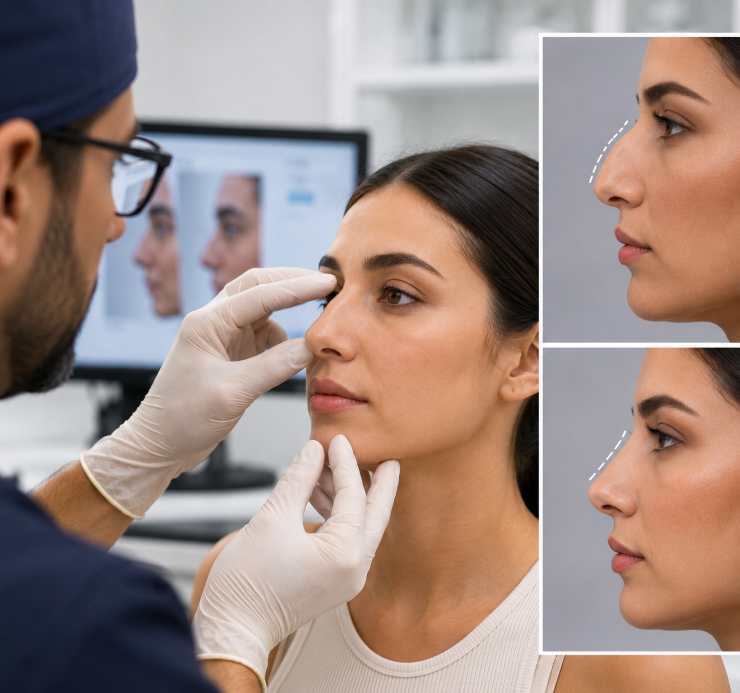
As a surgeon, one of the most common questions I hear in consultation isn't from someone considering their first nose surgery — it's from someone who has already had one, and isn't quite happy with how it turned out. If that's why you're reading this, I want you to know two things right away: you're not alone, and it's a fair question to ask. Not every rhinoplasty settles the way it should, and understanding why is the first step to deciding what, if anything, needs to be done next.
What Is Revision Rhinoplasty?
Revision rhinoplasty is a secondary nose surgery performed after a previous rhinoplasty, done to correct concerns that remained unresolved, developed during healing, or emerged only after the initial surgery had fully settled.
It isn't automatically needed after every nose job. Many people heal well and never think about it again. But for a smaller group, either the aesthetic result or the function of the nose (breathing) doesn't match what was expected — and that's where a revision procedure gets discussed.
Signs You Might Need Revision Rhinoplasty
Some concerns show up early. Others take a year or longer to become clear, since final results of a rhinoplasty only reveal themselves once all swelling has fully subsided.
Visible or Aesthetic Signs
- A visible bump, dip, or asymmetry that wasn't there in early healing photos
- The nasal tip looks pinched, too pointed, or oddly shaped
- One nostril appears noticeably different from the other
- The nose looks "over-operated" or unnatural from certain angles
- The bridge appears too narrow, too wide, or collapsed in places
Functional Signs
- Difficulty breathing through one or both nostrils
- A whistling sound while breathing
- Nasal congestion that wasn't present before the first surgery
- A feeling of internal blockage, especially at night
Structural Signs
- The nose feels unusually soft, weak, or unstable to the touch
- Visible scar tissue changes shape under the skin
- The tip droops or moves unusually when you smile or talk
If any of these sound familiar, it doesn't automatically mean something went wrong — sometimes it's simply how your body healed. But it's worth having it assessed.
Common Reasons Revision Surgery Becomes Necessary
In my experience, the reasons people seek a second opinion after rhinoplasty generally fall into a few categories:
1. Healing didn't go as expected: Scar tissue can form unevenly, cartilage can shift slightly during recovery, or swelling can settle asymmetrically — none of which is always predictable in advance.
2. The surgical plan didn't fully account for skin type: Thicker skin can hide fine reshaping, while thinner skin can reveal even small irregularities in the cartilage underneath. Getting this balance right matters enormously.
3. Breathing function was affected: Sometimes a nose looks aesthetically fine but the internal structure (like the septum or nasal valves) wasn't adequately addressed, leading to breathing difficulty.
4. Over-correction or under-correction: Too much cartilage removed can lead to a pinched or collapsed look over time. Too little correction can mean the original concern is still visible.
5. Trauma or injury after the first surgery: An accidental knock to the nose, even a minor one, can shift healing cartilage before it has fully stabilised.
How Long Should You Wait Before Considering Revision Rhinoplasty?
This is one of the most important — and most misunderstood — parts of the process.
A nose typically takes 12 to 18 months to fully heal from rhinoplasty. Swelling reduces gradually, and the final shape only becomes clear toward the end of this window, sometimes later for thicker-skinned noses.
Why waiting matters:
- Operating too early can disrupt healing tissue that would have improved on its own
- The "final" shape isn't visible until swelling has completely resolved
- A rushed revision can sometimes create new problems instead of solving existing ones
Patience during this phase, though frustrating, genuinely leads to better long-term decisions.
Is Revision Rhinoplasty More Complex Than the First Surgery?
Generally, yes. Revision cases tend to be more intricate because:
- Scar tissue from the first surgery changes how tissue responds during a second procedure
- Cartilage may have already been reshaped or partially removed, sometimes requiring cartilage grafts (often taken from the ear or rib) to rebuild structure
- Blood supply to the area may be altered after a previous surgery, which affects healing
- Achieving symmetry is technically harder when working with tissue that has already been operated on once
This is why revision rhinoplasty is generally regarded as a more specialised procedure than a first-time nose surgery, and why a thorough, structured evaluation matters more than ever at this stage.
What Happens During a Revision Rhinoplasty Consultation?
A proper consultation for revision surgery usually involves:
- A detailed history review — understanding what was done in the first surgery, and how healing has progressed so far
- A physical and functional examination — checking both appearance and breathing
- Photographic assessment — comparing pre-surgery, immediate post-surgery, and current appearance
- A discussion of realistic expectations — being honest about what revision surgery can and cannot achieve
- A tailored surgical plan — since no two revision cases are approached the same way
If you're researching cosmetic surgery for a second opinion after a previous nose surgery, this evaluation step is where clarity really begins — before any decision about surgery is made at all.
A Final Word
Choosing to explore revision rhinoplasty isn't about undoing a decision — it's about making sure your nose finally feels like yours, both in how it looks and how it functions. If you're still unsure whether what you're experiencing needs a revision at all, that uncertainty is exactly what a proper consultation is meant to resolve.
This kind of decision benefits from patience, a detailed clinical evaluation, and realistic expectations before any surgical plan is considered. Anyone exploring rhinoplasty in Mangalore, whether for a first surgery or a revision, is best served by a qualified plastic surgeon who can assess each case individually.
Author:
Dr. Chandra
Board-certified Plastic and Cosmetic Surgeon (MCh)
The Lead Surgeon at Radiant Roots Hair Transplant & Aesthetic Surgery Centre, Mangalore.
Frequently Asked Questions
1. How do I know if my nose surgery actually failed, or if I just need to wait longer?
If it's been less than a year since your surgery, it's often still healing — swelling and mild asymmetry are normal during this time. If it's been over 18 months and something still bothers you, functionally or aesthetically, that's a reasonable time to get it checked.
2. Is revision rhinoplasty more painful than the first surgery?
Not necessarily more painful, but recovery can feel a little different because of scar tissue from before. Most people describe the discomfort as manageable and similar in intensity to their first surgery.
3. Can revision rhinoplasty fix breathing problems too, or only how the nose looks?
Yes, in most cases. A good revision surgery looks at both the appearance and the internal structure, especially if breathing difficulty started after the first surgery.
4. Will my nose look "overdone" after a second surgery?
Not if it's approached carefully. In fact, revision surgery is often about restoring a more natural look after over-correction, not adding more changes.
5. Do I need to bring anything to my revision consultation?
Yes — bring photos from before your first surgery if you have them, along with any details about the procedure done earlier, such as the technique used or the surgeon's notes if available. This helps in planning the next steps accurately.
This content is for general educational purposes only and does not constitute medical advice. Outcomes vary between individuals. Please consult your surgeon for a personalised assessment before starting any treatment.