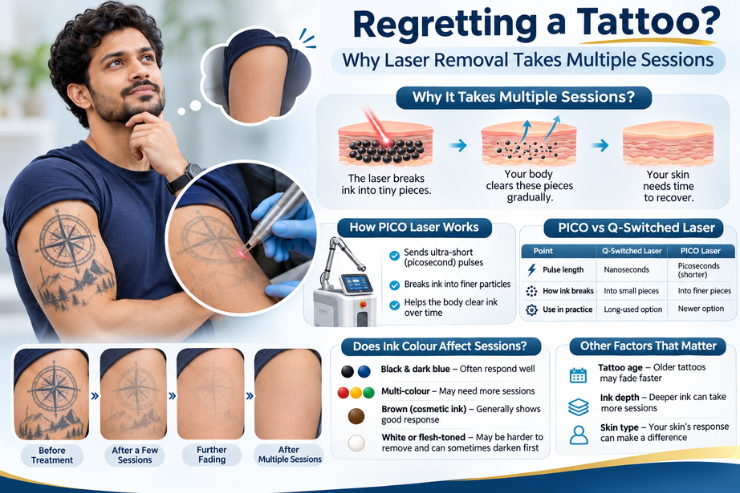
That tattoo you once loved may now feel like something you keep hiding under a sleeve. Laser removal can help fade it, but it works in stages, not in one sitting. Ink colour, ink depth, and your skin type all shape how many sessions you may need. Like any laser procedure, it carries some risks, such as temporary light or dark patches. Healing time and aftercare matter too, and results differ from person to person.
Why Can't a Tattoo Be Removed in One Laser Session?
A tattoo is not one flat layer of colour. According to research, ink is placed in layers, and a laser cannot safely break through all of them in a single session.
Here is what happens:
| What happens | Why it takes time |
| The laser breaks ink into tiny pieces | Only some layers can be treated safely at once |
| Your body clears these pieces | The body, not the laser, removes the ink, and this is gradual |
| Your skin recovers | Redness, swelling, or mild blisters need time to settle |
So each session works like peeling back one layer. The tattoo usually looks lighter after each treatment, though the pace differs for everyone.
How PICO Laser Tattoo Removal in Mangalore Works
"PICO" refers to picosecond, which is one trillionth of a second. The laser sends very short bursts of energy into the ink.
These short bursts aim to break ink into smaller particles, which the body may find easier to clear. Studies suggest that because tattoo particles react within less than 10 nanoseconds, picosecond pulses were expected to work better than nanosecond ones.
A typical session involves:
- A skin and tattoo check
- Numbing, since a numbing cream or injection can ease the discomfort
- Laser pulses over the tattoo
- Cooling and a protective dressing
PICO vs Q-Switched Laser: Does It Mean Fewer Sessions?
Both lasers are used for tattoo removal. Here is a simple comparison:
| Point | Q-switched laser | PICO laser |
| Pulse length | Nanoseconds | Picoseconds (shorter) |
| How ink breaks | Into small pieces | Into finer pieces |
| Use in practice | Long-used option | Newer option |
According to research, in one blinded review, 12 of 16 patients showed clearly more fading with picosecond treatment than with nanosecond treatment.
That said, the evidence is still growing. A review of studies found limited proof that picosecond lasers work better, mostly for black and blue ink. Another study found that both types gave acceptable fading for most tattoos.
Each option has its own advantages. The right fit depends on your tattoo and skin, and this is something you can weigh with your doctor.
Does Ink Colour Change How Many Sessions You Need?
Yes, it often does. Different colours absorb light differently. One laser cannot treat every ink colour.
| Ink type | What to know |
| Black and dark blue | Commonly treated; often studied |
| Multi-colour | May need more than one wavelength |
| Brown cosmetic ink (brows, lips) | Responded well to picosecond laser in an animal study |
| White or flesh-toned ink | Can respond poorly; some inks may darken first |
Studies found the picosecond laser more effective than the nanosecond laser for multi-colour tattoos. Your own response may still vary.
Why Ink Depth and Tattoo Age Affect Your Results
Before treatment, a few details about your tattoo need a careful look. These include how old the tattoo is, how deep the ink sits, its colours, and where it is on your body.
| Factor | How it may affect sessions |
| Ink depth | Deeper ink may need more sittings |
| Ink density | Heavily filled areas may take longer |
| Cover-up tattoos | More layers of ink to clear |
| Tattoo age | Older ink may behave differently |
Is PICO Laser Treatment in Mangalore Safe for Indian Skin?
Indian skin has more melanin, the natural pigment that gives skin its colour. Melanin can also absorb laser energy, so settings must be chosen with care.
Things worth knowing:
- Some people get light or dark spots after treatment, and these usually fade within 6 to 12 months.
- In studies of Asian patients, lighter skin patches were seen less often with the 1064 nm setting than with 532 nm.
- Laser removal needs a healthy immune system, and it is not done during pregnancy or breastfeeding.
A skin assessment helps decide whether PICO laser treatment in Mangalore suits you.
Factors That Decide How Fast Your Tattoo Fades
Beyond ink and skin, a few personal factors play a role:
- Size: Larger tattoos need more treatment time
- Location: Some body areas may clear at a different pace
- Medicines: Some may affect how your skin reacts
- Scar history: Past raised scars should be shared at consultation
- Consistency: Many people stop treatment before reaching their ideal result
How Long Should You Wait Between Laser Sessions?
The gap between sessions is part of the treatment, not a delay.
During this time:
- Your skin heals
- Your body keeps clearing broken ink
Rushing sessions does not usually speed up fading, and it may irritate the skin. The gap differs based on how your skin heals.
Aftercare That Helps Your Tattoo Fade Faster
Good aftercare supports healing and lowers the chance of side effects.
| Do | Avoid |
| Wash the area and apply ointment for a few days, as advised | Picking blisters or scabs |
| Keep the area moisturised and covered until healed | Hot baths or swimming until healed |
| Shield the area from sun for 3 months with clothing that fully blocks light | Thin fabrics that let light through |
Side Effects to Expect and When to Call Your Doctor
| Usually temporary | Call your doctor if you notice |
| Redness and swelling | Spreading redness or pus |
| Mild blisters | Blisters that keep growing |
| Light or dark patches | Wounds that do not heal |
Scarring, texture changes, and burns are more likely when the person treating you lacks medical training.
Why Medical Supervision Matters for Tattoo Removal
According to research, results depend largely on the person doing the removal.
Home methods carry real risks:
- There is no evidence that removal creams work, and many contain strong acids that may burn or scar.
- Rubbing salt into skin is very painful and can cause infection or scarring.
Whether you visit a cosmetic surgery clinic in Mangalore or elsewhere, you may wish to ask:
- Who will perform the treatment?
- Which lasers are available for different ink colours?
- What aftercare will I need?
Every Fade Begins With an Honest Conversation
A tattoo took one sitting to create, but fading it is a gentle, step-by-step process. Each session, each healing break, and each bit of aftercare plays its part.
If you are exploring PICO laser tattoo removal in Mangalore, take time to understand your options, ask questions, and decide at your own pace. A qualified doctor can examine your tattoo and help you weigh what suits your skin.
Author:
Dr. Chandra
Board-certified Plastic and Cosmetic Surgeon (MCh)
The Lead Surgeon at Radiant Roots Hair Transplant & Aesthetic Surgery Centre, Mangalore.
Frequently Asked Questions
How many sessions will my tattoo need?
There is no fixed number. It depends on ink colour, depth, size, location, and your skin type. A doctor can share a rough estimate after examining your tattoo, though the final count may differ.
Does PICO laser tattoo removal hurt?
Most patients describe it as uncomfortable rather than very painful. The feeling is often compared to a rubber band snapping on the skin. Numbing cream or an injection can help ease the discomfort.
Can a tattoo be removed completely?
Many tattoos fade a great deal, while some leave faint traces behind. Results depend on the ink and your skin. It helps to start with realistic goals, since outcomes vary from person to person.