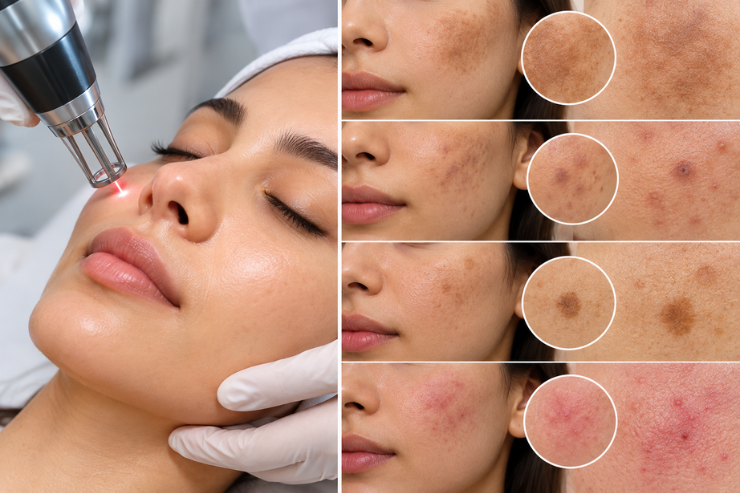
A brown patch on the face is often described with one broad word: pigmentation.
But clinically, pigmentation is not one condition.
A patch caused by melasma behaves differently from a sun spot. A brown mark left behind after acne has a different cause. Even two patches that look similar in the mirror may sit at different depths in the skin or respond differently to treatment.
That is why choosing a pigmentation treatment in Mangalore should begin with identifying what is causing the pigment rather than choosing a laser first.
Pico laser can have a role in selected pigment concerns, but it is not automatically the first or only treatment for every dark mark.
“Pigmentation” Is a Description, Not a Diagnosis
Pigmentation simply describes a change in skin colour. It does not tell us why that change has happened.
Some of the commonly confused pigment concerns include:
| Pigment concern | Common clue | What makes it different |
| Melasma | Symmetrical brown or grey-brown patches | Often chronic and influenced by light, hormones and other triggers |
| Post-inflammatory hyperpigmentation (PIH) | Dark mark after inflammation | Can follow acne, irritation, injury or procedures |
| Brown acne marks | Flat brown or grey spots after acne settles | Usually a form of PIH rather than a true scar |
| Solar lentigines / sun spots | Well-defined flat brown spots | Linked with cumulative sun exposure |
| Red acne marks | Pink, red or purple areas after acne | May have more of a vascular component than a pigment problem |
The diagnosis matters because these conditions do not behave in the same way.
Melasma: More Than Just Excess Pigment
Melasma commonly causes symmetrical patches over the cheeks, forehead, upper lip or other areas of the face.
It is usually a chronic pigment disorder, not simply a collection of pigment particles waiting to be removed.
What can influence melasma?
Factors may include:
- Sun exposure
- Visible light
- Hormonal changes
- Pregnancy
- Certain medications
- Genetic tendency
- Skin irritation in some individuals
Sun protection is therefore a central part of melasma management, regardless of whether a procedure is eventually considered.
Where does Pico Laser fit?
This is where treatment needs to be individualised.
A 2026 systematic review and meta-analysis assessed the 755-nm picosecond alexandrite laser for melasma. Across the five randomised studies included, triple-combination topical therapy reduced melasma severity more than the picosecond laser. Post-inflammatory hyperpigmentation was also reported more often with the picosecond laser than with topical creams.
Importantly, the authors rated the overall evidence as low certainty because the trials were small and varied.
This does not mean Pico laser can never be considered for melasma. It means pico laser for melasma should not automatically be treated as the first step for every patient.
Melasma often needs long-term trigger control, photoprotection and medical management. Procedures may have a role in selected cases after proper assessment.
Post-Inflammatory Hyperpigmentation: Treat the Trigger Too
Post-inflammatory hyperpigmentation, or PIH, develops after the skin has been inflamed or injured.
Common triggers include:
- Acne
- Eczema or dermatitis
- Scratching
- Burns
- Cosmetic procedures
- Irritating skincare
- Other skin inflammation
PIH deserves particular attention in Indian skin because darker skin tones can develop more noticeable and persistent pigmentation after inflammation.
A systematic review focused on skin of colour found that several treatments, including lasers, may improve PIH in selected patients. However, laser treatment can itself trigger or worsen pigmentation in some cases.
That leads to an important principle:
Before treating the pigment, control the inflammation producing it.
If active acne is still causing new pimples, focusing only on the older brown marks may result in a cycle where new pigmentation continues to appear.
Are Brown Acne Marks the Same as Acne Scars?
No, and this is one of the most common sources of confusion.
Brown acne marks
A flat brown, grey or blue-grey patch after acne is often post-inflammatory hyperpigmentation.
The colour changes, but the surface of the skin remains relatively flat.
True acne scars
A true acne scar changes the structure of the skin.
It may be:
- Depressed
- Rolling
- Narrow and deep
- Broad
- Raised
A treatment aimed mainly at pigment will not necessarily correct a structural scar.
The American Academy of Dermatology also distinguishes flat post-acne pigmentation from true acne scars.
What about red acne marks?
Pink, red or purple marks can have a stronger vascular component.
They should not automatically be treated as though they are the same as brown melanin-based pigmentation.
This is another reason why simply asking for a “pigmentation laser” may be too broad.
Sun Spots Behave Differently from Melasma
Solar lentigines, commonly called sun spots or age spots, usually appear as well-defined, flat brown spots on areas that have had repeated sun exposure.
Unlike melasma, they tend to be more localised.
A 2025 systematic review of 41 clinical trials found that several approaches have been studied for solar lentigines, including topical treatments, chemical procedures and different laser systems. Picosecond lasers showed promising results in the studies reviewed, but the authors also noted that more large-scale research is needed.
There is another important point.
A new, unusual or changing pigmented spot should not simply be assumed to be a cosmetic sun spot. Diagnosis should come before cosmetic treatment.
So, What Does Pico Laser Actually Do?
Picosecond lasers deliver energy in extremely short pulses.
Rather than relying mainly on prolonged heat, the short pulse can produce a strong photoacoustic effect that breaks pigment into smaller particles.
This is one reason Pico technology has attracted interest for pigment treatment, particularly where limiting unnecessary heat exposure is desirable.
A 2026 systematic review examining picosecond lasers in skin of colour reported generally mild and temporary adverse effects across the available studies and noted potential benefits for several pigment and non-pigment conditions.
But there is an important distinction:
Pico is a technology. Pigmentation is a diagnosis problem.
The presence of brown colour alone does not tell us whether Pico is the appropriate choice.
Why Can the Wrong Pigmentation Treatment Make Things Worse?
Melanocytes—the cells responsible for producing pigment—can react to inflammation.
If the skin becomes excessively irritated, some people can develop more pigmentation rather than less.
This is especially relevant in pigment-prone skin.
Factors that may affect the risk include:
- Skin tone
- History of PIH
- Type of pigmentation
- Depth of pigment
- Active acne or dermatitis
- Recent sun exposure
- Previous treatment reactions
- Laser wavelength and treatment settings
- Post-treatment skincare
- Sun protection
More aggressive treatment does not automatically mean faster or better results.
Sometimes the appropriate first step is reducing inflammation or improving photoprotection before a laser procedure is considered.
What Should Be Assessed Before Pico Laser?
For someone researching pico laser treatment in Mangalore, a useful consultation should answer more than “How many sessions?”
The assessment should first establish:
- What type of pigmentation is present?
- Is it superficial, deeper or mixed?
- Is there active acne or inflammation?
- Is the condition stable or continuing to change?
- Has the skin developed PIH after previous procedures?
- Has there been recent tanning or significant sun exposure?
- Could hormones, medicines or other triggers be relevant?
- Would topical treatment or another approach be more appropriate before a laser?
These questions help prevent very different pigment disorders from being treated as though they are the same.
The Diagnosis Should Come Before the Device
Pico laser has expanded the options available for selected pigmentation concerns. But the presence of pigmentation alone is not enough to decide whether a laser is appropriate.
Melasma, PIH, post-acne marks and sun spots may all look brown, but they differ in cause, depth, behaviour and likelihood of recurrence.
For anyone exploring pigmentation treatment in Mangalore, the more useful starting question is not:
“Which is the newest laser?”
It is:
“What type of pigmentation is this?”
Once that is clear, treatment can be planned around the actual condition rather than simply targeting the colour that is visible on the surface.
Individual responses vary. A qualified medical practitioner should assess the skin, medical history and type of pigmentation before recommending a personalised treatment approach.
Frequently Asked Questions
Can Pico Laser treat every type of pigmentation?
No. Different pigment disorders have different causes and behaviour. Some may be considered for Pico treatment, while others may be better managed initially with topical medication, trigger control or another approach.
Is Pico Laser always suitable for melasma?
No. Pico laser for melasma may be considered in selected situations, but current evidence does not support treating it as the universal first option.
Are dark acne marks permanent?
Many post-acne brown marks are PIH rather than scars and can gradually fade. The time required varies according to skin type, pigment depth, sun exposure and whether acne continues to cause inflammation.
Can Pico Laser make pigmentation darker?
Post-inflammatory hyperpigmentation can occur after laser procedures, particularly in pigment-prone skin. Appropriate diagnosis, treatment settings, skin preparation and aftercare therefore matter.
Author
Dr. Chandra
Board-certified Plastic and Cosmetic Surgeon (MCh)
The Lead Surgeon at Radiant Roots Hair Transplant & Aesthetic Surgery Centre, Mangalore.
References
- Chua KR, et al. Assessing the Safety and Efficacy of Picosecond Alexandrite Lasers in the Management of Melasma: A Systematic Review and Meta-Analysis of Randomised Control Trials. Australasian Journal of Dermatology, 2026.
- American Academy of Dermatology. Melasma: Diagnosis and Treatment.
- American Academy of Dermatology. Acne Scars: Signs and Symptoms.
- Mardani G, et al. Treatment of Solar Lentigines: A Systematic Review of Clinical Trials. Journal of Cosmetic Dermatology, 2025.
- Safety and Efficacy of Picosecond Laser Therapy in Skin of Color: A Systematic Review. JAAD Reviews, 2026.
- Treatment of Post-Inflammatory Hyperpigmentation in Skin of Colour: A Systematic Review.
This content is for general educational purposes and does not constitute medical advice. Individual results vary. Please consult a qualified medical practitioner for a personalised assessment.