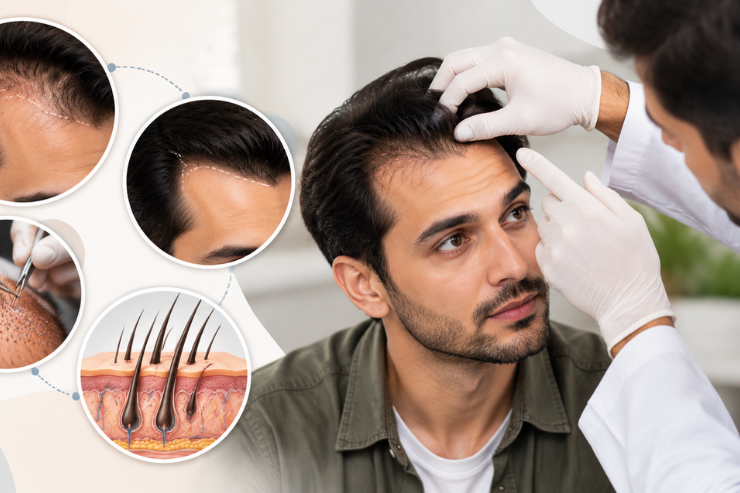
Noticing your hairline creeping back a little more each year? It's one of the first changes people in their 30s spot in the mirror, and it often brings a rush of questions. Along with that comes hesitation; concerns about visible scarring, unnatural-looking results, and general uncertainty.
Find out what's really happening to your hairline in your 30s, why this stage can be a clearer decision point than earlier years, and when non-surgical options are worth trying first. The right fit isn't always what people assume, and understanding your options can help you decide with confidence.
What's Actually Happening to Your Hairline
For most people, a receding hairline in the 30s comes down to androgenetic alopecia, also called pattern hair loss. It's a genetic, hormonal pattern where hair follicles become more sensitive to a hormone called DHT (a by-product of testosterone) and gradually shrink with each growth cycle, producing thinner strands over time.
- Temple recession is usually the first visible sign, often showing up before overall thinning starts, sometimes forming a gradual "M" shape
- General thinning affects the whole scalp evenly, and is often diffuse rather than concentrated at the hairline
- Hairline-specific recession is a distinct pattern and many people mix the two up, thinking one always means the other
A few other factors can speed up or add to hairline changes, such as ongoing stress, nutritional gaps, hormonal shifts, or certain medications. Knowing which pattern you're actually seeing helps guide the right next step.
Your 30s: A Clearer Decision Point
Hair loss patterns are usually more settled and predictable by your 30s compared to your early 20s, when things can still be shifting quite a bit.
- A more stable pattern makes transplant planning more accurate, since the extent of loss is clearer
- Surgeons can map the hairline and donor needs with better confidence at this stage
- Donor area hair also tends to be in good condition at this age, which matters since it's the hair being moved
- Diffuse thinning (spread across the scalp rather than at the hairline) often responds differently and may need a different approach altogether
This isn't a fixed rule. Some people stabilise earlier, others later, and an individual assessment is still the only way to know exactly where you stand.
Non-Surgical Options Still Worth a Look
Surgery isn't always the first step, and it doesn't have to stand alone either. Receding hairline treatment often starts with medical management before surgery even enters the conversation.
- Topical and oral medical management options are sometimes used to help slow further thinning
- Regenerative treatments, such as PRP therapy, are sometimes used to support scalp health
- Low-level laser therapy is another category some people explore for early-stage thinning
- These tend to suit early-stage or diffuse thinning better than well-established hairline recession
- In many cases, they're used alongside a transplant rather than instead of it
Your doctor can help you understand where you fit into this picture, and which category, if any, applies to your situation.
Where Does Hair Transplant Fit Into This?
Hair transplant for men in their 30s often becomes a genuine option at this stage, and hair transplant in Mangalore is increasingly sought out by people noticing early to moderate signs of recession.
| What Hair Transplant Does | What Hair Transplant Doesn't Do |
| Moves existing follicles from a donor area to thinning zones | Stop future hair loss in untreated areas |
| Creates a fuller-looking hairline | Guarantee the exact same look for everyone |
| Uses hair that's naturally more resistant to further loss | Work well if the donor area itself is limited or weak |
Whether it fits depends more on your donor supply and how far the recession has progressed than on age alone. This is also why very early, still-progressing hair loss sometimes calls for a wait-and-watch approach first as it gives the pattern time to settle before deciding on a treatment plan.
Are You a Good Candidate For Hair Transplant?
A few factors are looked at together, not in isolation:
- Donor area density and overall scalp health
- Extent and pattern of the recession, whether it’s early, moderate, or advanced
- Family history of hair loss, which can hint at how the pattern may progress
- Realistic goals discussed openly with your doctor
Cost is another common question at this stage. Hair transplant cost in Mangalore typically depends on the number of grafts needed, which ties directly back to how much recession has progressed. This conversation, covering candidacy and cost together, is where most of the real decision-making happens.
What to Expect During Hair Transplant Recovery?
- Week 1: Mild redness or swelling at the treated area, settling quickly
- Weeks 2 to 4: An early shedding phase is common, this is expected, not a sign of failure
- Months 3 to 4: New growth typically starts becoming visible
- Months 6 to 9: Density gradually builds as more follicles become active
- Months 9 to 12: Fuller results generally settle in by this stage
Individual results may vary, and healing can look a little different from person to person depending on scalp health and how well aftercare instructions are followed.
Myths That Confuse This Age Group
- "You're too young for this" or "you should've done it in your 20s."
Neither is accurate; suitability depends on your hair loss pattern, not a fixed age - "It stops all future hair loss."
It doesn't; untreated areas can still thin over time - "Results show up immediately."
Growth takes months to appear, and longer to fully settle in - "The donor area will look patchy afterward."
With careful planning, donor harvesting is usually spread out to avoid visible thinning there
Hair Transplant, Tailored to Your Hairline
A receding hairline in your 30s isn't unusual, and it doesn't call for a rushed decision. Some people in Mangalore find medical management enough to slow things down; others explore regenerative options like PRP; and for some, hair transplant becomes a genuine fit.
It is not a fit-for-all option. Things that help you to decide if hair transplant in Mangalore suits you or not depends on your donor supply, the extent of recession, and your own goals. If you're facing this kind of hairline change, a personalized assessment with a qualified doctor is the clearest way to know what your options look like, so that you stop guessing based on age or assumptions alone.
Author:
Dr. Chandra
- Board-certified Plastic and Cosmetic Surgeon (MCh)
- The Lead Surgeon at Radiant Roots Hair Transplant & Aesthetic Surgery Centre, Mangalore.
Frequently Asked Questions
Q1. Is 30 too young for a hair transplant?
The suitability depends on your hair loss pattern and donor supply, not age alone. Many people in their 30s are considered good candidates once their pattern has stabilised somewhat.
Q2. Will a transplant stop my hairline from receding further?
Transplanted hair stays, but untreated areas can still thin over time. Some people combine it with medical management to help slow further changes in other areas too.
Q3. How soon will I see results after a hair transplant?
Early growth is usually visible around 3 to 4 months, with fuller results generally settling by 9 to 12 months. Individual timelines can vary from person to person.
Q4. Can I try non-surgical options before deciding on surgery?
Yes, medical management or regenerative treatments like PRP are often tried first, especially for early or mild recession. Your doctor can help assess whether that's enough for you.
Q5. Does hair transplant cost in Mangalore depend on the number of grafts?
Yes, cost is closely tied to graft count, which depends on how much of the hairline needs coverage. A consultation gives a clearer, individualised estimate.
Disclaimer: This content is for general educational purposes only and does not constitute medical advice. Individual results may vary. Please consult your treating doctor for a personalised assessment before starting any treatment.